

We’re glad this article found its way to you. If you’re not a subscriber, we’d love for you to consider subscribing—your support helps make this journalism possible. Either way, we hope you enjoy the read. Click to subscribe: subscribing
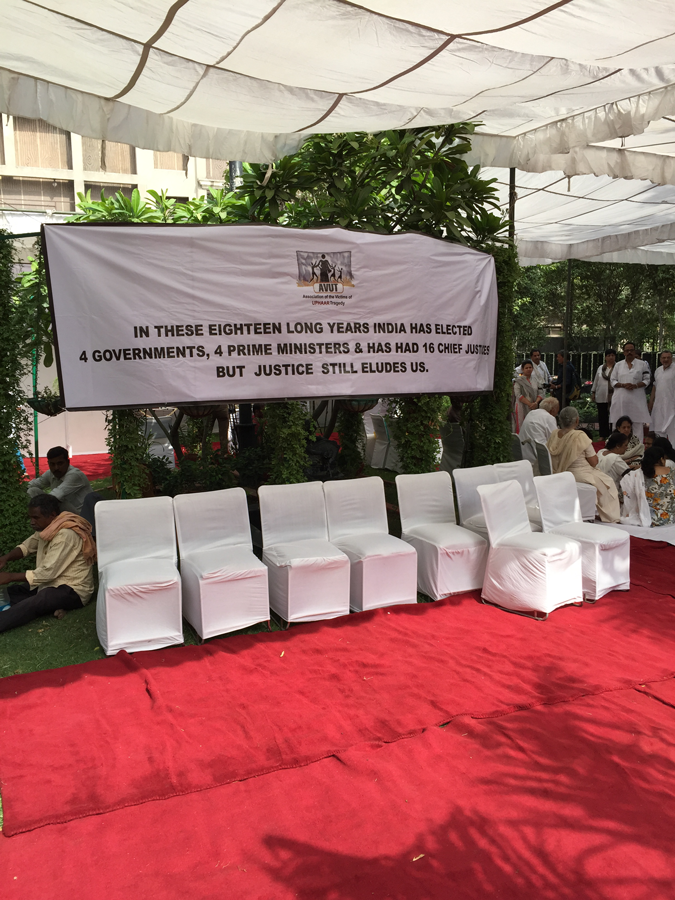
Eighteen years ago, on 13 June 1997, Neelam Krishnamoorthy—a resident of Kalkaji in South Delhi—bid farewell to her daughter and son as they went to watch the Bollywood film Border at the Uphaar Cinema in Green Park. They never came back. In the month after the fire that claimed their lives and the lives of 57 others, Neelam and her husband, Shekhar, came together with the families of other victims to form the Association of the Victims of the Uphaar Tragedy (AVUT). When the group first met, on 30 June 1997, only eight or nine people attended; Neelam and her husband found them by combing through obituaries. But, after the first meeting, AVUT members worked hard to reach others, and the group gradually grew to represent the families of every victim of the fire. As the president of the AVUT, Neelam has been the public face and private stalwart of the fight to ensure that the deaths were not in vain. Surrounded by other victims’ families at the annual memorial service on 13 June 2015, she mourned a second tragedy. Neelam handed out a press release that said, in part, “despite following the case relentlessly for the last eighteen years, AVUT has failed in its endeavour.”
The facts of the Uphaar fire and its aftermath have been widelyreported: a faulty power transformer, sparks in an overfilled garage, cars on fire, thick smoke rising into the theatre, pandemonium, cut power, blocked balcony exits, and 59 people killed by asphyxiation. For years before the fire, the building was a tinderbox, brimming with licensing violations and illegal additions. On the day of the tragedy, fire trucks took too long to reach the theatre; few ambulances ever arrived. It was an event extraordinary for its toll and scale, but the product of common failures and expected inconveniences: who has not been stuck in a traffic jam in Delhi, or entered a building that didn’t seem safe?
Early on, the AVUT had decided that it would not make its goal financial compensation. Naveen Sawhney, whose daughter was killed at Uphaar, told me when I met him on 26 May at his home, “We were not fighting for money, because money cannot bring back your children.” Instead, the group sought to create a deterrent against future tragedies. It wanted to make an example of Sushil and Gopal Ansal, the wealthy brothers who owned and operated Uphaar.
Two primary cases emerged to achieve this aim. The first was a civil case, commenced by a writ petition filed by the AVUT in July 1997. The case was intended to establish liability for the deaths and provide restitution for the victims’ families. It relied in part on the scathing Kumar Committee report, issued by the Deputy Commissioner for the South Government of the National Capital Territory (NCT) on 3 July 1997. The writ petition sought to hold accountable for the tragedy, the Ansal brothers, the Delhi Vidyut Board—that was formed by the Delhi government for the generation and distribution of power to the most regions of Delhi—the licensing authority, in this case the Office of the Commissioner of Police, which should have enforced the code violations in the building, and the Municipal Corporation of Delhi. The second was a criminal case, prompted by a Central Bureau of Investigation (CBI) charge sheet filed in November 1997 that aimed at punishing the perpetrators. Sixteen people were charged, including Sushil and Gopal Ansal, the repairmen responsible for the transformer, and the fire inspector.
Neelam had hoped that significant damages and severe enough punishments would deter business owners from treating safety concerns as superfluous to their business interests. “Unless you make a hole in their pocket, they’ll never feel the pinch of it,” she told me. If she could help to prevent another Uphaar from occurring, she explained, that would honour the memory of her children. That would be justice.
Neelam and Shekhar used to run a textile export company, but she has largely given up that job. She has lost her earlier friends, and doesn’t attend weddings or birthdays anymore. They remind her of the children she does not have. To fight against government lawyers and highly paid private advocates hired by the accused, she has devoted herself to memorising the details of the fire, the police reports, the witnesses’ comments and the charge sheets that were filed. KTS Tulsi, a Supreme Court advocate and a current member of the Rajya Sabha, first suggested the creation of a victim’s association after the fire, and subsequently served as the group’s lawyer. In the early days of the AVUT, he said, “We discovered ... that Neelam Krishnamoorthy was the most resourceful person.” She can now recite sections of legal precedent for cases such as these at will, and describe the winding path of the court cases in minute detail. She has become used to speaking in court, talking to lawyers, and calling the press.
In October 2011, after 14 years of adjournments, challenges, and appeals, the Supreme Court announced its judgement in the civil case. For victims over 20 years old, it reduced the compensation that was decided in the Delhi High Court ruling from Rs 18 lakh to Rs 10 lakh, and, for those under 20, from Rs 15 lakh to Rs 7.5 lakh. Although the Ansal brothers were ordered to pay 85 percent of this sum, Neelam believed that this amount was far too little to deter owners and businesspeople from making decisions that prioritised profits and cost savings over people. Neelam told me, “a message had to go into the society, we want people to respect safety laws and not compromise with [sic] them. And we have miserably failed.” Tulsi added, “it’s a pity: this judgment has made no impact.”
The results of the criminal case are, if anything, more disheartening. Of the 16 people charged with crimes related to the fire, at least six are dead. The Ansal brothers, the primary culprits in the eyes of Neelam and the AVUT, were found guilty of contributory negligence by the Supreme Court on 4 March 2014. Neelam had hoped that a stricter charge with a more rigid punishment—culpable homicide—would be given. The bench split on the issue of sentencing and, more than a year after the judgement, the Ansals are still free. Whatever the court ultimately decides, they will serve no longer than two years. Sushil will be credited for any time already served, the Supreme Court has tentatively decided, because of his advanced age. Neelam responded, “They’re old? My children were very young. I’m sorry, are you going to give a thought about the children who’ve died?”
There are still some lingering, undecided cases related to the tragedy. A case was registered against the Ansal brothers and others in 2006 for tampering with evidence; it is currently being heard in the District and Sessions courts in Delhi. Neelam considers it trivial compared to the civil and criminal cases, for which she once had high hopes. She wanted justice, to go up against the wealthy men and corrupt systems that killed her children and to win. Instead, she says, “All our effort of these 18 years has gone down the drain. It’s been worthless. We’ve been let down by the system.”
On 13 June 2015, a week ago, the victims’ families gathered to mark another year since their loved ones were killed. It was hot, and the 40 or so mourners flowed in slowly. Mostly, they looked blank, tired and weary. Before the ceremony began, Neelam weaved through the small crowd, greeting familiar faces, coordinating the service, and introducing herself to photographers and reporters. She and her husband handed out press releases and tied black bands around the arms of mourners. All of this seemed routine to her; she has had many years of practice. Then the ceremony began, and suddenly she was just another mother in a crowd, grieving for children. “You don’t stop being a mother just because your children are not there,” she had told me when we first met at her home in late May.
Correction: An earlier version of this article stated that Neelam Krishnamoorthy lived in Govindpuri. She lives in Kalkaji. We regret the error.
Thanks for reading till the end. If you valued this piece, and you're already a subscriber, consider contributing to keep us afloat—so more readers can access work like this. Click to make a contribution: Contribute